
-
Kilts
 Traditional, eight-yard knife-pleated kilt, the feileadh beag (or 'phi..
 Ideal for informal events and days out. They are especially good as starter..
 Always stylish, we make tailored Tartan Trews with years of experience. Whe..
 - Jackets
-
Sporrans
 Dress Sporrans are the most formal and eye-catching type of civilian sporra..
 The trusty 'all-rounder': not as informal as the Day Sporran, not as formal..
 The Day Sporran is a trusty, durable everyday accessory for your Highlandwe..
 Here you'll find quality sporran accessories and spares. Spruce up your out..
 -
Women
 Whether you’re heading out for a brisk evening walk or attending a sophist..
 Crafted with meticulous attention to detail, our waistcoat will feature yo..
 St Kilda’s Tweed blazers and waistcoats are meticulously handcrafted in Sc..
-240x240w.jpg "Handbags and Sporranbags") Looking for a practical bag that also celebrates your Scottish heritage? S..
Looking for a practical bag that also celebrates your Scottish heritage? S.. -
Accessories
 Kilt shoes, also known as Ghillie Brogues, are traditional Scottish footwea..
 Kilt socks, also known as kilt hose, are knee-high socks worn as part of tr..
 ..
.. ..
.. Here you will find buttons and swatches. We recommend swatches as the best..
 Kilt flashes are decorative garters worn with traditional long hose, servin..
 Here you will find the essential Hangers, Bags and Carriers for storing and..
 A tartan fly plaid is a traditional Scottish accessory; s a long, rectangul..
 -
Gifts
 ..
.. ..
.. ..
.. ..
.. Celtic artists from Scotland and Ireland have left a legacy which has endu..
 ..
.. ..
.. ..
.. ..
.. ..
.. ..
.. ..
.. ..
.. ..
.. -
Clan
 ..
.. ..
.. ..
.. ..
.. ..
.. ..
.. ..
.. ..
.. ..
.. ..
.. -
Clearance
 ..
.. ..
.. ..
.. ..
.. ..
.. ..
.. No waiting - all these hand-made sporrans are made up and ready to go. All ..
 ..
..




Crest Meaning: Clelland
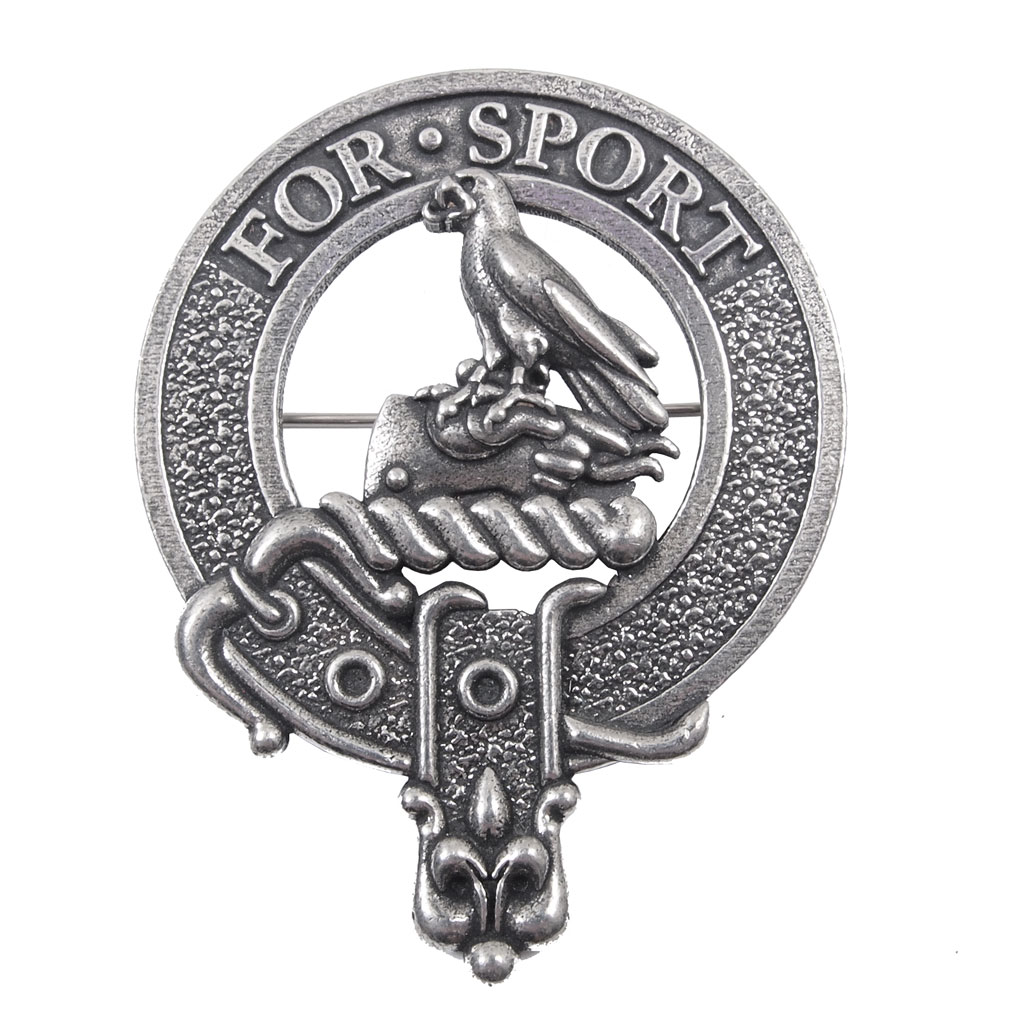
The Clelland Crest has some relatively straightforward symbolism. It was mentioned in 1722 Nisbet’s System of Heraldry, but has an older pedigree.
The Clellands (or Knelands) of that Ilk were hereditary foresters to the Earl of Douglas. A very important role in this job was in managing their woodlands in Lanarkshire. A crucial part of that job was managing the hunting stock. As such, the laird’s arms contain a hare with a hunting horn around its neck (first recorded around 1498), while the crest here has a hunting falcon with the falconer’s glove. The motto ‘for Sport’ hence relates to the ‘sport’ of hunting, rather than games in the modern sense.
Nisbet mentions the sport motto, although there was at the time another motto sometimes used, ‘non sibi’ meaning ‘not for himself’, a broad expression of service, a motto used by other families, sometimes with modifications such as non sibi patriae (not for himself, for the courty) non sibi cunctis (not for himself, for all) and so on.
During the medieval period foresters also had an important official and legal function, enforcing the laws within the forests, as well as a management role over the raw materials, such as the timber.
The Clellands have two branches in Northern Ireland, the Clelands (one L) and the Clealands. The placename 'Cleland' from which the kindred take their surname, means something like 'Clay-land' ie land with a lot of clay in the soil.
MKP 29 June 2023