
-
Kilts
 Traditional, eight-yard knife-pleated kilt, the feileadh beag (or 'phi..
 Ideal for informal events and days out. They are especially good as starter..
 Always stylish, we make tailored Tartan Trews with years of experience. Whe..
 - Jackets
-
Sporrans
 Dress Sporrans are the most formal and eye-catching type of civilian sporra..
 The trusty 'all-rounder': not as informal as the Day Sporran, not as formal..
 The Day Sporran is a trusty, durable everyday accessory for your Highlandwe..
 Here you'll find quality sporran accessories and spares. Spruce up your out..
 -
Women
 Whether you’re heading out for a brisk evening walk or attending a sophist..
 Crafted with meticulous attention to detail, our waistcoat will feature yo..
 St Kilda’s Tweed blazers and waistcoats are meticulously handcrafted in Sc..
-240x240w.jpg "Handbags and Sporranbags") Looking for a practical bag that also celebrates your Scottish heritage? S..
Looking for a practical bag that also celebrates your Scottish heritage? S.. -
Accessories
 Kilt shoes, also known as Ghillie Brogues, are traditional Scottish footwea..
 Kilt socks, also known as kilt hose, are knee-high socks worn as part of tr..
 ..
.. ..
.. Here you will find buttons and swatches. We recommend swatches as the best..
 Kilt flashes are decorative garters worn with traditional long hose, servin..
 Here you will find the essential Hangers, Bags and Carriers for storing and..
 A tartan fly plaid is a traditional Scottish accessory; s a long, rectangul..
 -
Gifts
 ..
.. ..
.. ..
.. ..
.. Celtic artists from Scotland and Ireland have left a legacy which has endu..
 ..
.. ..
.. ..
.. ..
.. ..
.. ..
.. ..
.. ..
.. ..
.. -
Clan
 ..
.. ..
.. ..
.. ..
.. ..
.. ..
.. ..
.. ..
.. ..
.. ..
.. -
Clearance
 ..
.. ..
.. ..
.. ..
.. ..
.. ..
.. No waiting - all these hand-made sporrans are made up and ready to go. All ..
 ..
..




The Lordship of the Isles - Part 3
Somerled’s death at the battle of Renfrew to the forces of the Bishop of Glasgow in 1164 essentially ended the kingdom of the Isles. Although his forces outclassed and outnumbered the Scots, the men of the Isles being joined by forces of the King of Dublin, Somerled himself was killed early in the battle and, without a leader, his forces disintegrated. Likewise his kingdom now fragmented, with rival Viking warlords seizing the opportunity to attack, and the succession within the kingdom being disputed by Somerled’s sons. This led to its territory being divided.
The kings of Scots now pressed their advantage. Their ancestors had once dominated the west before the Viking invasions and claimed sovereignty even though this had been a dead letter. Taking advantage of the long-term power vacuum, in 1249 Alexander II led an expedition to assert his control of the western seaboard, but he died on campaign. Despite this reprieve, his successor, Alexander III, continued this effort, bringing the Isles firmly under Scottish control, even seeing off King Haakon of Norway in the process after the Battle of Largs.
So it seemed at this point that the Isles would now end their independence and become absorbed into the Scottish kingdom, and that may have been the case if not for the sudden death of King Alexander in 1286. The lack of a successor would see Edward I invade Scotland, and in the ensuing Wars of Independence would reinvigorate the Lordship of the Isles.
Somerled had had five sons and one daughter. In the long term, two lines are especially important for what came next: Dugald and Ranald. Dugald was the progenitor of the MacDougalls, the Lords of Argyll, while Ranald was the progenitor of the MacDonalds, MacRory and MacAlisters, among others.
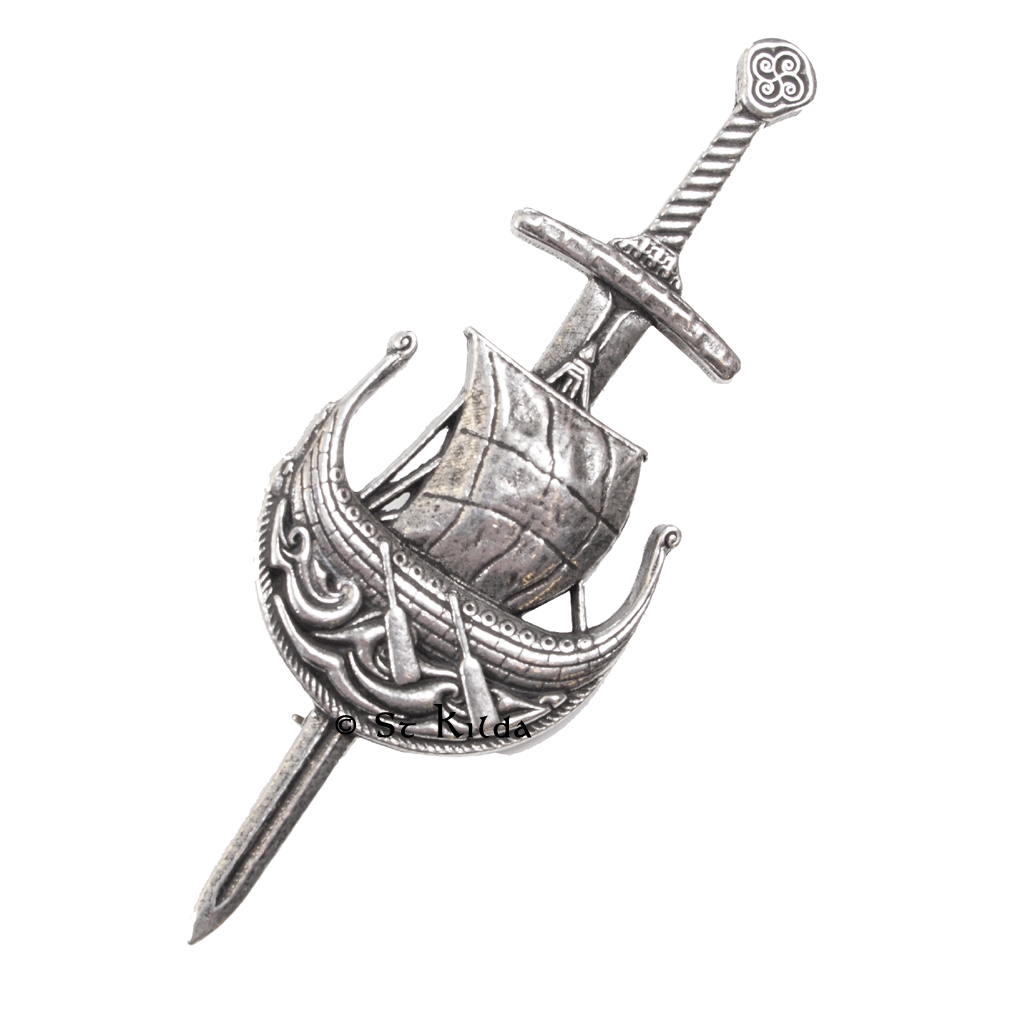
Our West Highland Kilt Pin. In the centre is the Birlinn, or galley, which was essentially a Viking Longship with the addition of a rudder. These little craft were the lifeblood of the isels through the middle ages. This is set upon a West Highland battle sword - smaller than the Highland Claymore, this was an ideal weapon for use at sea and for raiding from the ships.