






-240x240w.jpg "Handbags and Sporranbags")





















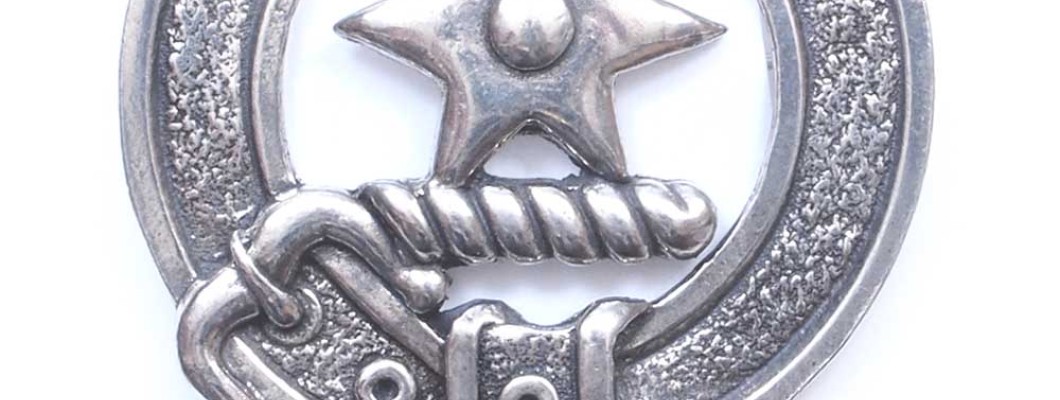
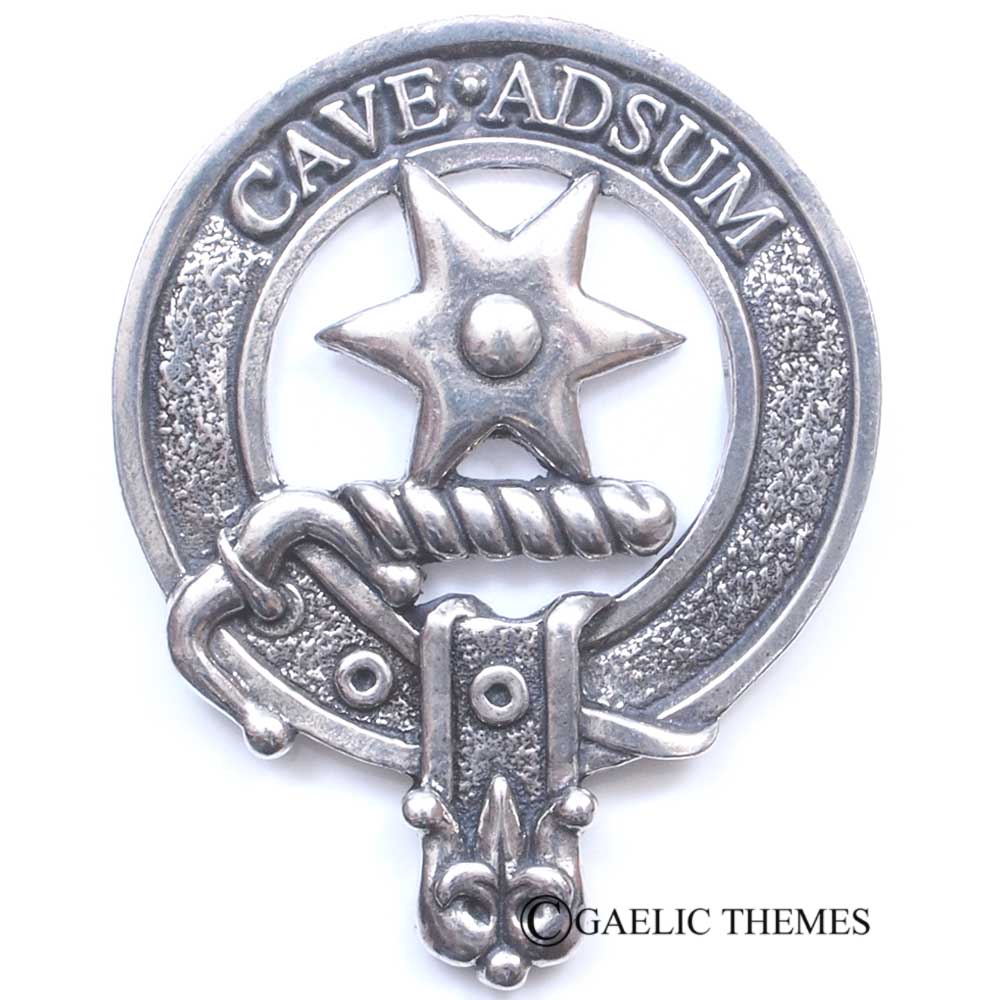
The Jardine crest is a spur rowel of six points—the star-shaped wheel attached to the back of a horseman’s spur. As a heraldic charge it is both martial and kinetic, evoking speed, control, and the intimate relationship between rider and horse. Accompanying it is the succinct and rather threatening motto Cave adsum, meaning “beware, I am present”, a phrase that neatly reinforces the crest’s aggressive and watchful character.
Early sources suggest that the Jardine crest was not always so unequivocal. In Timothy Pont’s manuscript of 1624, the crest of Jardine of Applegirth is recorded instead as a heron holding a laurel in its beak—a more classical and pacific emblem, perhaps intended to convey vigilance, dignity, or victory. The now-familiar spur rowel, paired with Cave adsum, was formally registered much later, in 1706, by John Jardine (as noted by R. R. Stoddart in Scottish Arms: Being a Collection of Armorial Bearings 1370–1678, p. 163). Nevertheless, it is possible that the spur had long been associated with the family, even if it had not previously been fixed as their official crest.
This possibility is supported by earlier evidence. Sir Alexander Jardine of Applegirth used a seal dated 1593 that shows three star-like charges on his shield (William Rae MacDonald, Scottish Armorial Seals, 1904, pp. 179–80). These have traditionally been identified as stars, but they may instead represent stylised spur rowels, later misunderstood by heraldic artists or recorders.
Whatever the precise evolution of the device, the symbolism is unmistakably apt. The Jardines were a prominent Borders family, famed for their horsemanship and deeply entangled in the riding culture of the Marches. When paired with its stark motto, the spur suggests swift, ever-present movement—an image of sudden appearance and implied threat, perfectly suited to a reiving lineage and a frontier way of life.
MKP 20 Jan 2026