
-
Kilts
 Traditional, eight-yard knife-pleated kilt, the feileadh beag (or 'phi..
 Ideal for informal events and days out. They are especially good as starter..
 Always stylish, we make tailored Tartan Trews with years of experience. Whe..
 - Jackets
-
Sporrans
 Dress Sporrans are the most formal and eye-catching type of civilian sporra..
 The trusty 'all-rounder': not as informal as the Day Sporran, not as formal..
 The Day Sporran is a trusty, durable everyday accessory for your Highlandwe..
 Here you'll find quality sporran accessories and spares. Spruce up your out..
 -
Women
 Whether you’re heading out for a brisk evening walk or attending a sophist..
 Crafted with meticulous attention to detail, our waistcoat will feature yo..
 St Kilda’s Tweed blazers and waistcoats are meticulously handcrafted in Sc..
-240x240w.jpg "Handbags and Sporranbags") Looking for a practical bag that also celebrates your Scottish heritage? S..
Looking for a practical bag that also celebrates your Scottish heritage? S.. -
Accessories
 Kilt shoes, also known as Ghillie Brogues, are traditional Scottish footwea..
 Kilt socks, also known as kilt hose, are knee-high socks worn as part of tr..
 ..
.. ..
.. Here you will find buttons and swatches. We recommend swatches as the best..
 Kilt flashes are decorative garters worn with traditional long hose, servin..
 Here you will find the essential Hangers, Bags and Carriers for storing and..
 A tartan fly plaid is a traditional Scottish accessory; s a long, rectangul..
 -
Gifts
 ..
.. ..
.. ..
.. ..
.. Celtic artists from Scotland and Ireland have left a legacy which has endu..
 ..
.. ..
.. ..
.. ..
.. ..
.. ..
.. ..
.. ..
.. ..
.. -
Clan
 ..
.. ..
.. ..
.. ..
.. ..
.. ..
.. ..
.. ..
.. ..
.. ..
.. -
Clearance
 ..
.. ..
.. ..
.. ..
.. ..
.. ..
.. No waiting - all these hand-made sporrans are made up and ready to go. All ..
 ..
..




How to use Tartan Designer
Designing a Tartan
As with all art mediums tartan design can reach an end result which may or may not appeal to the end viewer - there is no formula or 'correct' approach. A simple check may be more effective than a complex stripe sequence - yet some of the most effective tartans do have more complex sequences. A simple range of colours may be more effective than a large diverse range but again some effective tartans use a wide but closely co-ordinated range of colours. If you are serious about design it is worth looking at some existing registered tartans noting ones that appeal (and maybe those that are especially unappealing) and analysing aspects like the choice of width of adjacent stripes, whether a pattern exists within the sett itself, colours - close or complimentary, etc.
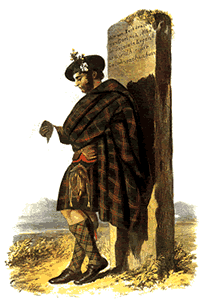
There are some 'tricks' or techniques that are used. Some argue that the essence of tartan design lies in recognising the combination of the mirroring of the stripe sequence combined with the horizontal and vertical replication - this resulting in a level of pattern form belying its basic components. Use of colour sequences in different widths of stripes can be used effectively. Highlighting of wide bands of dark color with narrow bands of light colour can emphasise a pattern that may otherwise be lost - this is sometimes referred to as the 'under-stripe' and the 'over-stripe'.
Although a tartan is essentially abstract i.e. the same pattern can be scaled from very small as perhaps used in a silk tie up to large as in a woollen blanket - scale still has to be taken into consideration. If, for example, the sett size is doubled a kilt would look very different from one made from the standard sett. Many registered tartans are in fact the 'same' tartan but at different scales.
Keith Lumsden, a tartan researcher of many years experience based in Scotland, has written a short guide to designing tartan