
-
Kilts
 Traditional, eight-yard knife-pleated kilt, the feileadh beag (or 'phi..
 Ideal for informal events and days out. They are especially good as starter..
 Always stylish, we make tailored Tartan Trews with years of experience. Whe..
 - Jackets
-
Sporrans
 Dress Sporrans are the most formal and eye-catching type of civilian sporra..
 The trusty 'all-rounder': not as informal as the Day Sporran, not as formal..
 The Day Sporran is a trusty, durable everyday accessory for your Highlandwe..
 Here you'll find quality sporran accessories and spares. Spruce up your out..
 -
Women
 Whether you’re heading out for a brisk evening walk or attending a sophist..
 Crafted with meticulous attention to detail, our waistcoat will feature yo..
 St Kilda’s Tweed blazers and waistcoats are meticulously handcrafted in Sc..
-240x240w.jpg "Handbags and Sporranbags") Looking for a practical bag that also celebrates your Scottish heritage? S..
Looking for a practical bag that also celebrates your Scottish heritage? S.. -
Accessories
 Kilt shoes, also known as Ghillie Brogues, are traditional Scottish footwea..
 Kilt socks, also known as kilt hose, are knee-high socks worn as part of tr..
 ..
.. ..
.. Here you will find buttons and swatches. We recommend swatches as the best..
 Kilt flashes are decorative garters worn with traditional long hose, servin..
 Here you will find the essential Hangers, Bags and Carriers for storing and..
 A tartan fly plaid is a traditional Scottish accessory; s a long, rectangul..
 -
Gifts
 ..
.. ..
.. ..
.. ..
.. Celtic artists from Scotland and Ireland have left a legacy which has endu..
 ..
.. ..
.. ..
.. ..
.. ..
.. ..
.. ..
.. ..
.. ..
.. -
Clan
 ..
.. ..
.. ..
.. ..
.. ..
.. ..
.. ..
.. ..
.. ..
.. ..
.. -
Clearance
 ..
.. ..
.. ..
.. ..
.. ..
.. ..
.. No waiting - all these hand-made sporrans are made up and ready to go. All ..
 ..
..




What is Tartan?
Tartan can initially appear complex in design but is based on a simple concept - a pattern of stripes which repeats in both a horizontal and verticle direction - in weaving terms the 'warp' and the 'weft'. A sequence of stripes (the sett) starting at one edge is repeated but in reverse order round a 'pivot' point. The sett reverses again and repeats round a second pivot point - see diagram 'A'. This process continues for the width of the material in question. The same sett and mirroring sequence occurs in the weft - diagram 'B' - continuing for the entire length of the material. The resulting combination of warp and weft is the tartan - diagram 'C'. (Note that the pivots themselves are not doubled in the mirroring process).
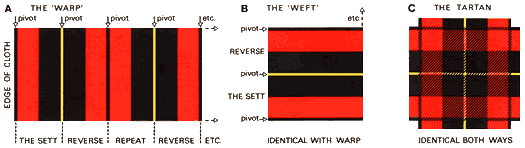
Illustrations by Don Pottinger
Some tartans - known as 'asymetrical' or 'non mirrored' do not reverse the sequence at the pivot points but simply repeat the sett in the same sequence. A very small number of tartans have different thread counts for the warp and the weft.

A description of a tartan can be written in a format known as the 'thread count' or the 'sett'. This identifies the colour and width of the stripes between two pivot points and incorporates the same information for the pivot points themselves. It takes the form of e.g. B16, LG8, K4, G24, K6 - reading the sequence from the left. The outside threads (B16 and K6 in the example given) are the pivot points. The colour is determined by a one to three letter shorthand - 'K' for example is black, 'B' is blue, 'LG' is light green and so on. The number after the letter is the proportional measurement - it does not matter what unit of measurement is used as the actual tartan pattern will remain the same - reflecting the abstract nature of tartan design. Traditionally the number refers to the number of threads used to set the loom but this can of course vary depending on the type and weight of thread used - modern tartan fabric can be made from silk, wool, cotton, poly-viscose, etc. In addition tartan designs are now used extensively on non-woven materials - paper, plastics, packaging, wall coverings, etc. although some claim that a tartan needs to be woven before it can be considered a 'true' tartan.