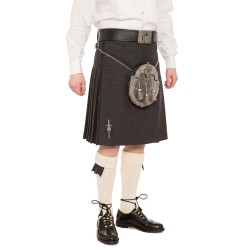
Box-pleat kilts are an alternative to the more usual 'knife-pleat' kilts (which we offer in five yards or eight yards).
The box pleated-kilt was the universal type of Feilidh beag (or little kilt) in the late eighteenth, and for most of the nineteenth centuries. This was the family of kilt worn by the Highlanders at Waterloo for example. After 1854 the modern knife-pleat kilt was introduced and by the end of that century the traditional 4 or 5 yards of cloth had expanded to the modern 8 yards. Yet the traditional box-pleat kilt has been making a come back in recent years, and will make an interesting alternative to your standard 8-yard kilt. Here we have a traditional box-pleated kilt, made with 4 to 5-yards of cloth (depending on the sizes and patterns) - giving you an authentic construction, while also retaining a bit of weight.
As with all our kilts, this garment is Made in Scotland by our own trained kilt makers. They are fully canvas lined with 3 buckles to ensure an excellent fit. Our kilts, properly kept and treated, will last you a lifetime. Please note that the depth of pleat will depend on the tartan sett.
The kilt is machine stitched and hand finished from 5 yards of worsted wool, available in our full range of tartans from Lochcarron of Scotland, Marton Mills, Strathmore Woollens and House of Edgar.
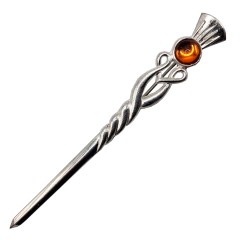
Kilt pin and sporran may be purchased separately. This item is made to order in our own tailoring workshop in Glasgow, with a standard delivery time of 5 to 6 weeks. If you need it sooner please select the option above.
Box pleated kilts are always pleated to the stripe. Where the tartan has several stripes, you have the option to choose which colour stripe you'd like to focus on - just type your preferred stripe colour in the text box - otherwise our kilt makers will choose the more prominent.
Tartan Finder Disclaimer:
As each of the mills has supplied their own images, or they have been taken from fabric samples, please note that the setts are not to scale when comparing tartans of different mills. Also, as screen resolutions vary, colours may differ slightly from those seen here. If unsure, we’d encourage you to purchase a swatch of the fabric before buying.
Measuring advice:
Waist: measure firmly around waist at navel (belly button) height.
Seat: measure around the largest part of the seat area.
Kilt Length: measure from the top of the hip at navel height (so the measure curves over the top of the hip bone) to the top or middle of the knee. As a rule of thumb, your kilt length should be no shorter than a third of your height. It's always best to get someone to help with this measurement, as you'll lean forward and shorten the length when doing it yourself.
Height: provide this in feet and inches.
Don't worry if these seems daunting, it's not as hard as it might sound! We have many years experience making kilts for people of all sizes, and will check with you if anything seems unusual.
If you have any queries regarding the measurement process, the pleating options, or would like some additional information before placing your order please contact us.
Tartan Ranges supported (all pure wool) can be found under the tartan finder button. Prices vary depending on the range.
What’s the difference?
Each mill uses different methods, looms and finishes on
their cloth.
In general, heavyweight is perhaps the best material for
making kilts, it looks and feels great, while also being fairly crease resistant
(when the kilt is treated and kept properly anyway). However, it’s not always
best for warm climates, and sometimes folk prefer a lighter option, so
mediumweight is a great alternative. Lightweight would be recommended especially for very warm climates.
Strathmore (W60) and House of Edgar (Mediumweight and Old and
Rare - but not their Nevis, Hebredian or Emblem ranges) have a traditional selvedge
made on a shuttle loom, which means the bottom of the cloth (and so the kilt)
is exactly the same thickness as the rest of the cloth. These traditional edges
are only available in the mediumweight cloths.
Marton Mills and Lochcarron use a tuck-in selvedge, where
the end threads are ‘tucked’ back into the weave. This means the bottom half-inch
of the cloth (and the kilt) can be a little thicker than the rest (not too much
though, and not enough to distort the shape of the pleating at the back). It
also means the tucked threads can poke up out of the cloth.
Don’t worry if this doesn’t mean anything to you! Both are
of kilting quality and produce a kilt that will last you a lifetime. The
difference is subtle and can be apparent on close inspection, but not so much
from a distance.
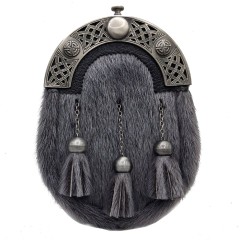
This sporran will be your lifelong friend. Made to the highest standards of Scottish craftsmanship, you may have other sporrans over time, but this wi..
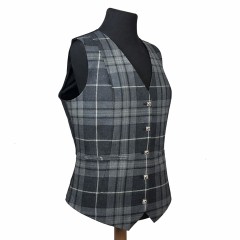
Buying a kilt or other tartan garment is a big investment. Our kilts are made to last a lifetime, so it's usually worth checking the tartan is exactly..
A Day Sporran meant to evoke the stately Baronial lifestyle of the Victorian and Edwardian period. Something sturdy, practical but elaborate, just lik..
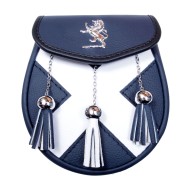
Our new Saltire Day Sporran, celebrating Scotland's national flag, featuring a rampant lion on the flap. This is a playful day sporran for informal oc..
Buying a kilt or other tartan garment is a big investment. Our kilts are made to last a lifetime, so it's usually worth checking the tartan is exactly..





-240x240w.jpg "Handbags and Sporranbags")